
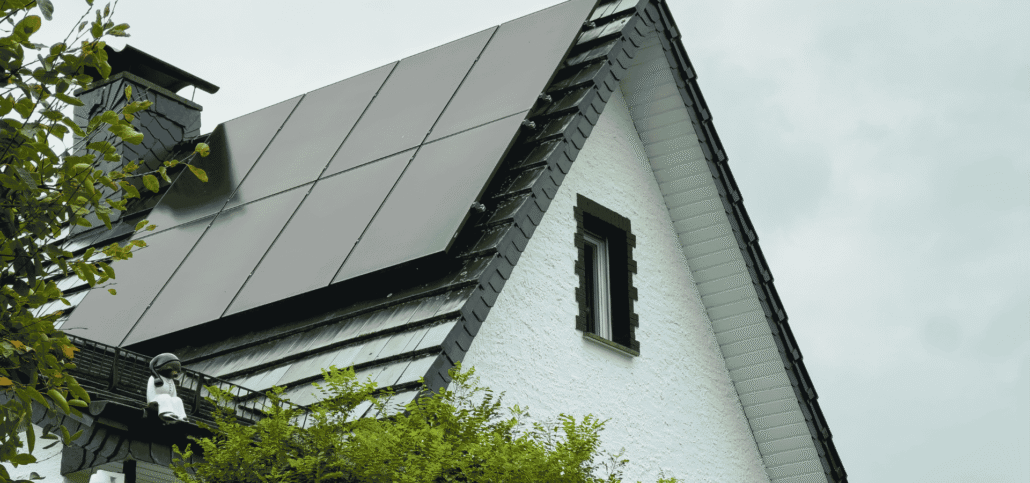
Do Solar Panels Work on Cloudy Days? Solar Panels in the Pacific Northwest
When it comes to solar power, homeowners in the Pacific Northwest often wonder if we get enough sun here to make solar panels worth it. While the concern is understandable, with the Pacific Northwest being famously gray, we’re going to explore how solar still works in cloudy weather.
Cloudy weather doesn’t mean solar-unfriendly. Germany, for instance, is a global solar leader with a climate similar to that of Oregon and Washington. So, let’s delve into how you might save money by using solar panels, even in the Pacific Northwest.
How Solar Panels Work on Cloudy Days
It’s a common myth that solar only works with direct sunlight. Solar panels actually run on daylight, whether it’s diffused light or direct sunlight. While cloud cover decreases solar panel energy output, it doesn’t eliminate it. Modern solar panels utilize the “photovoltaic effect” allowing them to capture light across a range of wavelengths. Photovoltaic cells capture both direct and indirect UV radiation, allowing solar to work, even on cloudy days.
PNW Sunlight by the Numbers
In solar terms, peak sun hours are defined as “an hour of sunlight that reaches an average of 1,000 watts of power per square meter (around 10.5 square feet).” Peak sun hours are different from total hours of daylight. Peak sun provides the highest output from solar panels, but daylight hours still produce meaningful energy.
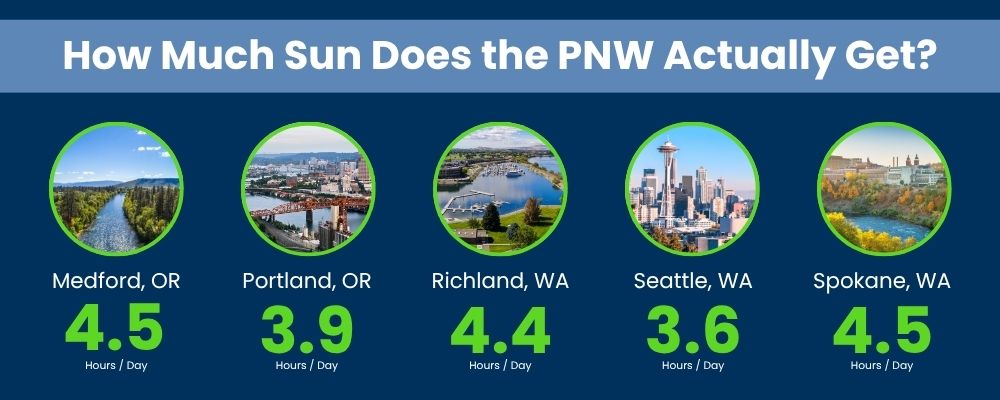
In the Pacific Northwest, cities get an average of 3 to 4 peak sun hours per day annually. Here are the annual peak sun hour averages for a handful of major cities in the Pacific Northwest.
- Medford, OR: 4.5
- Portland, OR: 3.9
- Richland, WA: 4.4
- Seattle, WA: 3.6
- Spokane, WA: 4.5
These peak sun hours are not much lower than most other areas in the United States, averaging 4 to 6 hours per day.
PNW Solar Panel Incentives
Living in the Pacific Northwest, you may be eligible for solar panel and other clean energy incentives. Many local utility companies offer incentives or rebates for homeowners who invest in clean energy upgrades, including solar panels.
Oregon Solar + Storage Rebate Program
The Oregon Solar + Storage Rebate Program issues rebates for solar electric systems for residential customers and low-income service providers in Oregon. Starting June 2026, ODOE now has $1.1 million available for this round of the Oregon Solar + Storage Rebate Program.
Washington Tax Exemptions
In Washington state, qualifying equipment for solar energy systems smaller than 100 kilowatts is exempt from state and local sales and use taxes (ESS Senate Bill 5116). Larger solar energy systems between 101 and 500 kilowatts may receive a 50% tax exemption.
Washington Net Energy Metering
Net energy metering is also available in Washington for homeowners with solar systems. Homeowners can purchase electricity from their local provider when needed and send electricity generated by their solar panels back to the local grid when not needed.
Is Your Home a Good Candidate for Solar?
Solar panel systems provide energy savings that help cover the total system cost over time. The first thing to consider is your average monthly energy consumption. Solar is generally advantageous for homes that use more than 500 kWh per month. Solar is a good investment for the majority of homeowners in Oregon and Washington.
The direction your roof faces also affects the effectiveness of solar panels. South-facing roofs are exposed to the sun for the longest period during the day. West-facing roofs are also viable for solar. Panel positioning is also important for maximum utilization of sunlight. For best results, panels should be angled so that the horizon is equivalent to your latitude minus 15 degrees, and at a site that’s free from tree cover.
Connect with Residential Electricians with PPNW
Interested in getting solar panels installed? Powering Pacific Northwest (PPNW) connects homeowners in Oregon and Washington with skilled residential electricians. Our electrical professionals are licensed, bonded, and insured for peace of mind.
Find a contractor to see if solar panels are the right choice for you.

