
The Homeowner’s Guide To EV Charging Stations
Electric vehicles (EVs) are increasingly common among residents of the Pacific Northwest. Oregon and Washington both have high EV adoption rates due to their sustainability. Are you wondering if electric car charger installation is worth it for you?
In this article, we’ll look at the different types of chargers, panel upgrade requirements, permit considerations, and the importance of professional installation.
Level 1 vs. Level 2: Which Charger Do You Need?
Choosing the right type of EV charger is dependent on your driving habits, home, and budget. There are two levels of EV chargers to consider: Level 1 and Level 2.
Level 1
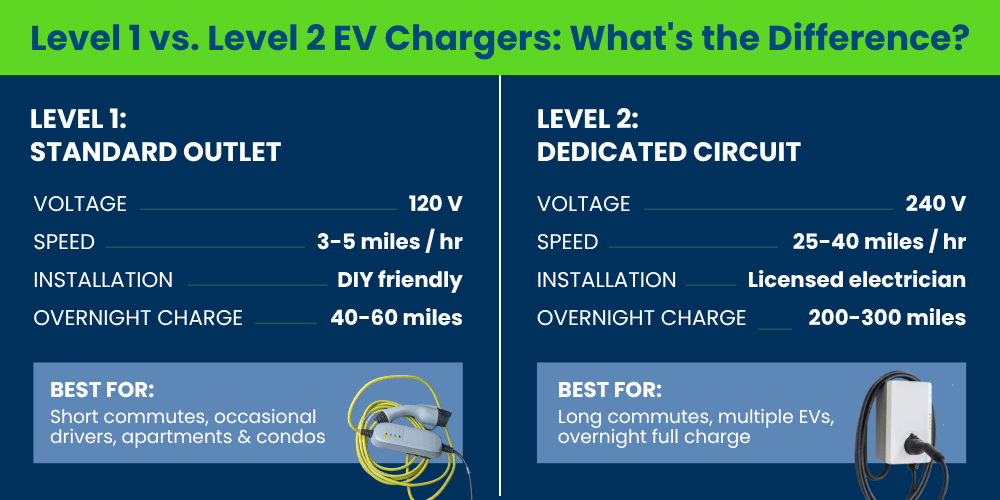
A Level 1 EV charger uses a standard 120V outlet, just like a lamp or TV would. Outlets for this type of charger are commonly found inside garages and at condos or apartments. You typically don’t need to worry about professional installation with Level 1 chargers and can begin charging right away.
However, Level 1 chargers offer much slower charging speeds. These chargers add 3 to 5 miles of range to your vehicle per hour, on average. Level 1 chargers may be suitable for those with short commutes.
Level 2
A Level 2 EV charger uses a 240V outlet, similar to a dryer or oven. Level 2 chargers require professional installation, but offer much faster charging speeds for overnight charging. They typically add 25 to 40 miles of range to your vehicle per hour.
If you have a long commute for work or multiple electric vehicles, a Level 2 charger is recommended.
Now that you understand the differences between Level 1 and Level 2 EV chargers, let’s discuss whether you’ll need an electrical panel upgrade.
Does Your Electrical Panel Need an Upgrade?
If your home was built before 2000, it likely has a 100-amp panel. If this is the case, depending on your power demands, your electrical panel may not be able to handle a Level 2 charger alongside existing electrical loads.
If you have an older home and an electrical panel that’s near capacity, you may need an electrical panel upgrade. In addition, if you plan on running an EV charger with a heat pump or other 240V appliances, you could risk overloading your electrical panel without an upgrade.
Electrical panel upgrades add cost to EV charger installation, but in turn add long-term home value. Oregon and Washington also offer utility EV charger rebate programs that you may be eligible for. Check with local utilities and research federal tax credits for 200-amp upgrades to support Level 2 chargers.
Permits & Local Requirements in Oregon and Washington
Most jurisdictions require electrical permits for EV charger installs. Level 2 EV chargers are not DIY projects and should be handled by a licensed electrician. Additionally, Oregon and Washington both have specific inspection requirements regarding EV chargers.
A licensed electrician will handle pulling permits for EV charging station installation.
Why Professional Installation Matters
When it comes to Level 2 EV charger installation, professional expertise is critical. Working with a licensed and insured professional helps ensure your safety, as 240V circuits aren’t forgiving of mistakes. It’s also important to work with a qualified professional for code compliance.
Additionally, most EV charger manufacturers require professional installation to honor the warranty. During an electric car charger home installation, the electrician can also help set up smart charger features like scheduling and load management that require proper setup.
PPNW for EV Charger Installation
Interested in getting an EV charger installed at home? Powering the Pacific Northwest connects homeowners in Oregon and Washington to licensed electrical professionals. Our residential electrical pros are highly knowledgeable about Level 2 EV chargers and prioritize safety and accuracy in every install.
Find a contractor today.

